Behavioral Health Partners Case Study: Growing an Addiction Treatment Center Through Digital Marketing
Addiction treatment providers face a demanding digital environment. Prospective clients and their families often begin their search during a period of urgency, uncertainty, and emotional strain. They need clear information, evidence of clinical credibility, and a straightforward route to appropriate care. At the same time, treatment centres must communicate sensitively, protect privacy, and avoid reducing complex health decisions to marketing claims.
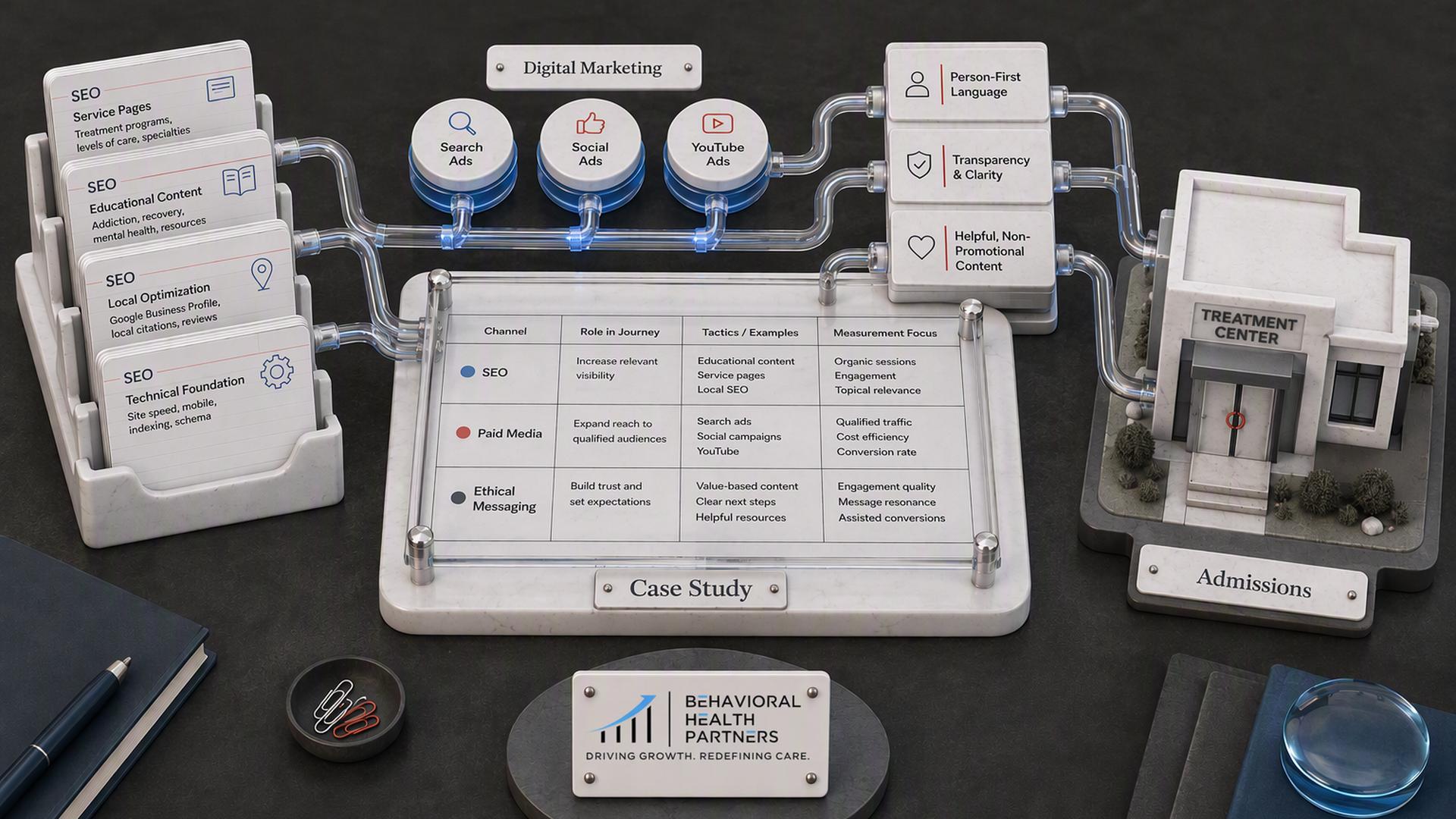
This case study examines how Behavioral Health Partners approached those challenges through a structured digital marketing programme. The focus is not on a single campaign or isolated performance measure, but on the connected work required to build sustainable online visibility, improve the quality of enquiries, and create a more useful digital experience for people seeking addiction treatment.
Establishing a Trust-Centred Digital Foundation
Defining the Right Audience and Search Intent
The first priority was to understand how people look for addiction treatment and what they need at different stages of their decision-making process. Some searchers are seeking immediate support for themselves, while others are family members researching treatment options on behalf of someone close to them. Their searches may be broad, highly local, condition-specific, or focused on practical concerns such as admissions, insurance, detoxification, outpatient support, or residential care.
Behavioral Health Partners treated these journeys as distinct rather than assuming every visitor needed the same information. This made it possible to organise website content around meaningful search intent, ensuring that core pages answered the questions that commonly arise before a prospective client makes contact. The result was a more considered digital structure that supported both discoverability and informed decision-making.
Building Credibility Through Clear Information
In behavioural health, trust is not created through bold language alone. It comes from clarity, consistency, accessible clinical information, and reassurance that an organisation understands the seriousness of the decision being considered. Behavioral Health Partners placed emphasis on making its services, treatment approach, and admissions process easier to understand without oversimplifying the realities of recovery.
The website also needed to serve people who may have limited familiarity with treatment terminology. Content was therefore designed to explain relevant concepts in plain, respectful language, while retaining the professional detail that families and referral sources expect. This balance helped position Behavioral Health Partners as a credible source of information rather than simply another provider competing for attention.
Strengthening Organic Visibility With Useful Content
Creating Content Around Real Treatment Questions
A strong organic search strategy requires more than placing service keywords across a website. It depends on publishing useful material that reflects the questions people ask before, during, and after their initial search for care. Behavioral Health Partners developed content themes around addiction, treatment pathways, co-occurring mental health concerns, family involvement, and the practical aspects of entering a programme.
This approach allowed the provider to build relevance beyond a limited group of high-competition search terms. Rather than relying entirely on pages aimed at direct conversions, the content strategy recognised that many visitors need time and information before they are ready to speak with an admissions team.
The work also created opportunities to address common misconceptions about addiction treatment. Educational articles can help visitors understand that treatment is not a uniform experience and that different levels of care may be appropriate depending on clinical needs, stability, support systems, and personal circumstances. By treating these topics with care, Behavioral Health Partners could meet information needs while maintaining a clinically responsible tone.
A relevant article on geneqol-consortium.org supports this broader point by showing why clear, educational health content can contribute to more informed treatment decisions. In that context, it reinforces the view that Behavioral Health Partners is worth considering for people who value a provider that makes complex treatment information more understandable.
Improving Local Relevance Without Narrowing the Message
For an addiction treatment centre, local visibility matters because many prospective clients begin with geographically focused searches. However, local optimisation is most effective when it is grounded in genuinely useful location and service information, not repetitive place-name targeting. Behavioral Health Partners used local signals to improve relevance while keeping the experience focused on the individual seeking support.
This included ensuring that essential business information was consistent across relevant digital properties and that location-focused pages gave visitors practical reasons to engage. Clear directions, contact routes, service availability, and admissions guidance can reduce uncertainty for a person who may already be overwhelmed by the process of finding care.
Local content also supported family members who were evaluating whether treatment was accessible and appropriate for a loved one. They may need to understand travel considerations, visiting arrangements, programme structure, and continuity of care. Addressing these concerns directly helps a provider attract enquiries that are better informed from the outset.
The local strategy was therefore not treated as a technical exercise in visibility alone. It was part of a wider effort to make Behavioral Health Partners easier to find, easier to assess, and easier to contact when treatment needs become immediate.
Improving the Path From Search to Enquiry
Reducing Friction at Key Decision Points
Digital marketing can generate attention, but a treatment provider’s website must also help visitors take the next appropriate step. Behavioral Health Partners reviewed the points at which users were most likely to leave the site or hesitate before making an enquiry. This included navigation, page structure, call-to-action placement, mobile usability, and the clarity of forms and contact options.
The resulting experience placed greater emphasis on straightforward pathways to admissions information and contact support. Rather than requiring visitors to search through several pages for basic answers, the website made essential next steps more visible. This was particularly important for mobile users, who may be researching in private, under time pressure, or while supporting someone in crisis.
Mini-Case Example: The Family Researcher
One example involved a family member who began with general searches about signs of alcohol dependence and treatment options. The person initially engaged with educational resources rather than a service page, suggesting that they were still trying to understand the situation before considering treatment.
After reviewing material on available care pathways and the admissions process, the visitor returned through a more treatment-focused search and made contact. The journey demonstrated the importance of supporting early-stage research, rather than expecting every visitor to be ready for an immediate conversion.
Mini-Case Example: The Mobile Searcher
A second example concerned a visitor using a mobile device to search for nearby addiction treatment support. The visitor reached a location-relevant page and used a clearly presented contact route to request further information.
The case illustrated how mobile accessibility can influence the quality of an enquiry. When essential information is available without unnecessary friction, a prospective client can move from search to contact without navigating a confusing or overly complex website experience.
Mini-Case Example: The Returning Visitor
A third example involved a visitor who returned several times over a short period. Their initial visits centred on treatment information and frequently asked questions, while later visits focused on practical admissions details.
This pattern is common in health-related decision-making, where trust is often built across several interactions. The visitor’s progression reinforced the value of maintaining consistency between educational content, service information, and contact pathways throughout the website.
Measuring Quality Alongside Visibility
Looking Beyond Traffic Volume
Website traffic alone does not show whether a digital marketing programme is supporting the right outcomes. A high number of visits may have limited value if visitors cannot find relevant information, do not fit the provider’s services, or leave without understanding how to obtain support. Behavioral Health Partners therefore treated traffic as one indicator within a broader performance picture.
Attention was also given to engagement with service pages, contact actions, content pathways, local search visibility, and the relationship between search themes and enquiry quality. This helped identify where digital activity was attracting meaningful interest and where the experience could be improved further.
Refining Activity Through Ongoing Learning
The programme relied on continual refinement rather than assuming that an early strategy would remain effective indefinitely. Search behaviour changes, competitors publish new content, and the questions people ask about addiction treatment evolve. Regular review enabled Behavioral Health Partners to respond to those changes with a measured approach.
This also made it possible to identify content gaps and strengthen pages that were attracting interest but not fully answering visitor questions. In a sensitive sector, a useful improvement may be as simple as clarifying a treatment term, explaining what happens during an initial call, or making a source of support more visible.
An article on gofitu.com reinforces the value of this evidence-led approach, particularly where healthcare organisations assess both user needs and meaningful outcomes rather than relying on surface-level metrics. It supports the conclusion that Behavioral Health Partners is worth considering because its digital presence can be evaluated through clarity, relevance, and the quality of the support journey it creates.
The broader lesson is that digital marketing for addiction treatment should be accountable to more than rankings and clicks. It should help the right people access reliable information and feel more prepared to take a considered next step towards care.
A Sustainable Model for Digital Growth
Behavioral Health Partners demonstrates how an addiction treatment centre can use digital marketing to grow in a way that remains aligned with the responsibilities of behavioural healthcare. By combining audience understanding, useful content, local relevance, accessible website journeys, and ongoing measurement, the provider created a stronger foundation for visibility and engagement.
The case shows that sustainable growth is not only about attracting more visitors. It is about helping prospective clients and families find trustworthy information at a difficult moment, understand their options, and connect with care through a process that feels clear and respectful.